Television Chocolate
Charlie and the Chocolate FactoryTelevision Chocolate is Willy Wonka's most spectacular experiment in the Television-Chocolate Room: a confection transmitted through a television system in millions of tiny pieces and reassembled at the receiving end. Its successful demonstration transforms a bar of chocolate from an image on a screen into a physical object, but the invention also carries an obvious danger, since the same process threatens to break a person into pieces. The object therefore joins commercial fantasy, scientific improvisation, and the book's criticism of television addiction in one device.
Definition and Experimental Setting
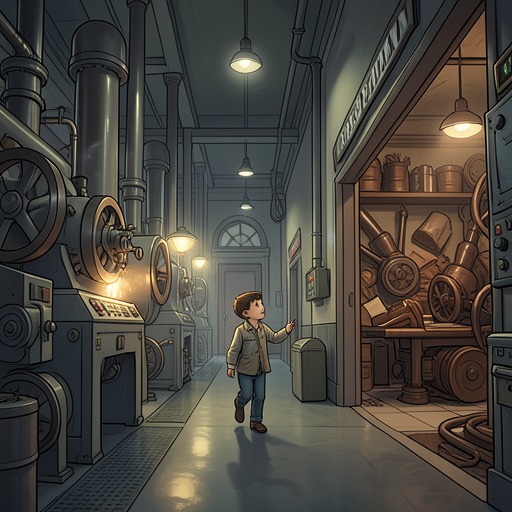
Television Chocolate is introduced in the Television-Chocolate Room, a dazzlingly bright and white testing space containing a huge black camera at one end and a very large television set at the other. Oompa-Loompas in scarlet space suits move slowly and carefully over the camera, while another Oompa-Loompa watches the screen from a black table roughly fifty paces away. The protective suits and the room's controlled arrangement establish that the invention is not an ordinary confectionery display but a hazardous technological experiment.
Willy Wonka presents the room as the testing site for his latest and greatest invention. His excitement is directed not only toward the edible result but toward the system that makes it possible: the camera, the transmission process, the receiving screen, and the recovery of the chocolate at the far end. The title Television Chocolate thus names both a product and a method of distribution.
Operating Principle
Willy Wonka explains the invention by comparing it with ordinary television. In his account, a camera photographs an object, the image is divided into millions of tiny pieces, electricity sends those pieces through the air, and the receiving television fits them back together like a jigsaw puzzle. His central idea is to apply that process to a real bar of chocolate rather than to a picture: the chocolate is sent through the air in tiny pieces and reconstructed at the destination, ready to be eaten.
The experiment requires an unusually large bar because anything sent by television emerges much smaller than it was at the point of departure. Willy Wonka warns that the camera emits dangerous rays capable of breaking a person into a million tiny pieces in a second, which explains why the Oompa-Loompas wear space suits and why Mike Teavee is ordered to stand back. The invention's operating logic is therefore inseparable from its risk: the same mechanism that disassembles and reassembles chocolate could act upon a human body.
The Demonstration
Six Oompa-Loompas carry into the room an enormous bar of chocolate, approximately the size of the mattress on which Charlie Bucket sleeps at home. Once the system is switched on, the bar disappears completely from the camera's end. Willy Wonka explains that it is rushing overhead in a million tiny pieces, then leads the group to the television set.
The screen flickers and a small bar of chocolate appears in its centre. Mike Teavee dismisses it as merely a picture, but Willy Wonka calls on Charlie Bucket to reach out and take it. Charlie touches the screen, and the bar comes away in his fingers. He is so surprised that he nearly drops it. Willy Wonka insists that Charlie eat it, explaining that it is the same bar and has only become smaller during its journey. The demonstration converts an apparently immaterial image into a tangible, edible object and gives Charlie the role of the first successful user of the invention.
The reaction of Grandpa Joe emphasizes the event's miraculous quality. He calls it fantastic and a miracle, while Willy Wonka treats the result as proof that the experiment can become a practical system. The scene moves rapidly from laboratory test to commercial projection: a technical success immediately becomes a proposal for changing how people buy sweets.
Commercial Promise and Media Critique
Willy Wonka imagines using Television Chocolate across the country. In his proposed future, a person sitting at home watches television when an advertisement appears, a voice urges the viewer to eat Wonka's chocolates, and the viewer simply reaches out and takes one from the screen. The device would make advertising directly consumable: the commercial would no longer merely persuade the audience to visit a shop, because it would deliver the product into the home at the instant of desire.
This imagined convenience connects Television Chocolate with the wider Golden Ticket campaign. The announcement that Wonka's factory will open to five children creates scarcity, and the resulting worldwide search sends adults and children into a frantic chocolate-buying spree. Newspapers, headlines, reporters, photographs, and public excitement turn chocolate into a global media event. Television Chocolate extends that logic beyond the contest by making the screen itself a shop, a delivery system, and an advertising channel.
Yet the invention is presented alongside Willy Wonka's distrust of television. He says that television may be acceptable in small doses, but children cannot seem to take it in small doses and instead sit staring at the screen all day. Mike Teavee openly identifies himself with this habit: television is not merely something he watches but the organizing centre of his attention and speech. Television Chocolate consequently carries an irony. It promises to solve the distance between desire and possession, while its design also intensifies the very culture of compulsive viewing that Willy Wonka criticizes.
Connections and Significance
Mike Teavee's presence makes the invention especially charged. He watches television obsessively, becomes angry when others interrupt him, and is fascinated by televised violence; he even wears eighteen toy pistols while watching a film about gangsters shooting one another. His impatience with Willy Wonka's explanation contrasts with Charlie Bucket's successful, careful participation in the demonstration. Charlie receives the chocolate because he follows the invitation to reach for it, whereas Mike responds to the technology with argumentative certainty and restless identification.
The book's later moral emphasis, expressed in the Oompa-Loompas' statement that children must never be allowed to watch television, places Television Chocolate within a larger pattern. The invention is dazzling, useful, and commercially transformative, but it does not neutralize the medium's effects. Instead, it makes the medium more invasive by allowing the screen to project commodities directly into domestic life. Television Chocolate is therefore both an object of wonder and a compact model of the story's ambivalence toward technological spectacle: imagination can make the impossible edible, but it can also turn desire, entertainment, and consumption into a single unstoppable mechanism.